
The Impact of AI on Supply Chain Management
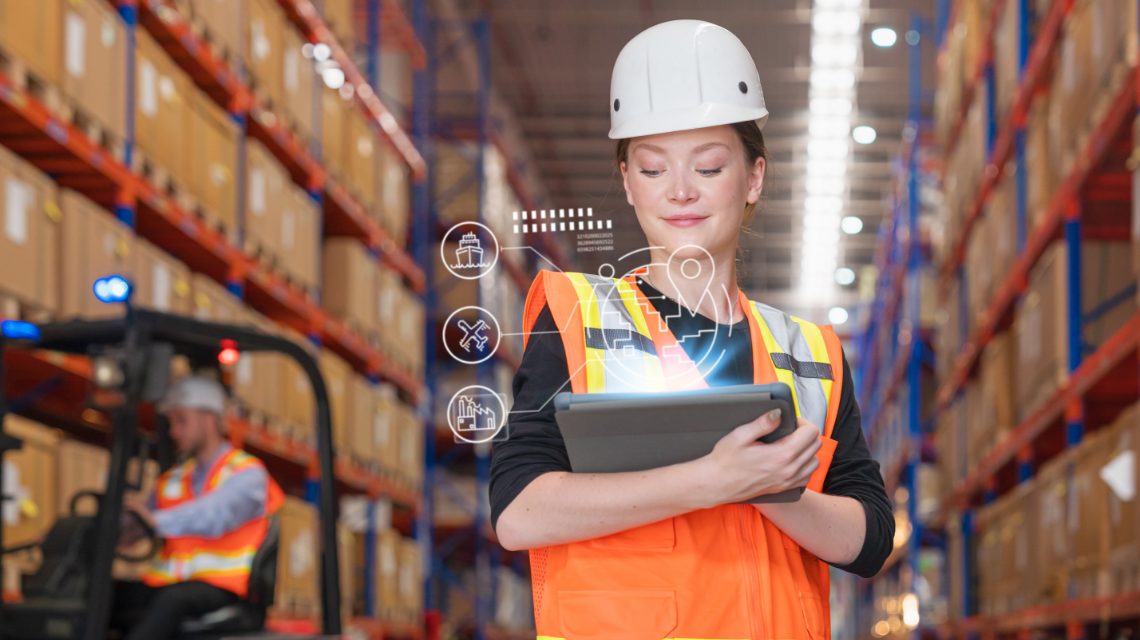
The supply chain, in its broadest definition, has been around for thousands of years. But the modern, integrated supply chain has been developing since the 1980s, around the same time British logistician Keith Oliver coined the term in a 1982 interview with the Financial Times.
Oliver couldn’t have predicted some of the technologies that would advance the field he named. Arguably, the most important technology to shape the industry’s future is artificial intelligence (AI).
“We are at the beginning stages of AI being incorporated into the supply chain,” says Toney Ferguson, DBA, faculty in the Purdue Global School of Business and Information Technology. “By analyzing large datasets, we can better anticipate demand, streamline logistics, automate warehouse operations, and reduce costs. This can result in faster, more efficient supply networks.”
How is AI being used to improve supply chain management, and what should prospective supply chain professionals know about its potential? We sat down with Ferguson to learn more.
AI Uses in the Supply Chain
AI functions in supply chain management fall into five categories, according to the Association for Supply Chain Management (ASCM):
1. Predictive Forecasting
By analyzing historical data alongside customer behavior, market trends, and external signals, AI is able to predict product demand with greater accuracy than its human predecessors.
“Many companies rely on past sales averages to predict demand, but when customer buying patterns change, it can create major problems in the supply chain,” Ferguson says. “Artificial intelligence can proactively analyze data points such as historical sales by SKU and region, retailer point-of-sale data, current inventory levels, supplier lead times, and transportation constraints, enabling it to anticipate changes and find solutions even before the problem materializes.”
2. Improved Inventory Management
By evaluating past sales, seasonality, and other variables, AI helps determine optimal stock levels and provides more precise reorder timing.
“AI can determine what to ship, how much to ship, when to ship, and to which location,” Ferguson says. “AI can select the best shipping routes by analyzing traffic patterns, weather, fuel cost, and delivery priority.”
3. Autonomous Supply Chains
With real-time data from connected devices and sensors, AI can process information automatically, leading to faster and more precise decision-making.
“A team of supply chain analysts can perform these same functions, but they cannot do so in real time,” says Ferguson. “AI constantly monitors this real-time data, making changes instantly and communicating the best route to drivers via GPS. The analysis of product movement is even more impactful in global shipping, where products are transported via ships, trucks, and other modes.”
4. Risk Management and Resilience
AI supports more proactive risk management by continuously monitoring data to detect potential disruptions before they escalate. Humanoid robots can be used for labor-intensive, repetitive, and hazardous jobs, reducing risk to human employees.
“Humanoid robots can help unload trailers and manage inbound shipments, tasks that can be physically demanding for humans,” Ferguson says. “They are best suited for hazardous environments, such as refrigerated warehouses, where temperatures must be kept at 32 degrees or lower, and for ergonomically difficult jobs where humans repeatedly have to bend to pick items from low locations or lift heavy loads.”
5. Personalized Customer Experience
AI-powered analytics uncover patterns in customer preferences and behavior, allowing organizations to deliver more tailored, relevant experiences.
“Amazon is a good example of an organization using AI to predict buying patterns,” Ferguson says. “When a shopper adds an item to their cart, the AI algorithm will offer recommended items to add as well. AI-powered analytics can offer recommended packaging solutions to improve purchasing and shipping efficiency.”
Misconceptions and Limitations of AI in the Supply Chain
For all its advantages in the supply chain, AI has its limitations, too.
“Artificial intelligence requires a mature organization with significant data, so data quality is the key before implementing an AI solution,” says Ferguson. “Inaccurate or inconsistent data can make AI worse, not better, for supply chain operations.”
Integrating AI into operations also takes a substantial software and technology investment. According to Ferguson, startups may have difficulty moving directly to using AI without clearly defined processes.
It’s important to remember that artificial intelligence is a tool. It performs best when there is a stable data flow and disciplined processes.
“Artificial intelligence can improve supply chain performance, but it cannot be used in all organizations,” Ferguson says. “Automation applied to efficient operations will magnify efficiency, but the same works in reverse. Automation applied to an inefficient operation will magnify the inefficiencies.”
Artificial intelligence is not a quick fix for outdated and inefficient processes. AI can help optimize organizational processes, but it does not make organizational problems disappear.
What Skills Should Supply Chain Management Students Have?
Supply chain students should be comfortable with technology because a growing segment of the supply chain is becoming automated. “Understanding robotics and data analytics will go a long way in this industry,” says Ferguson.
Being knowledgeable about various enterprise resource planning platforms will be critically important in managing organizations’ resources. Learn the basics of AI platforms; for example, many enterprise resource planning platforms, such as SAP, embed AI into their systems.
“There is an industry expectation that all supply chain professionals understand the role of data within the supply chain,” Ferguson says. “Data is the lifeblood of any AI program, and there will be exponential growth of jobs like AI-enabled demand planner, digital transformation analyst, procurement intelligence, and logistics optimization specialist.”
These new roles will require expert knowledge of a subset of the supply chain domain along with the ability to use AI tools.
Earn an Online Bachelor's Degree in Applied Supply Chain Management
Purdue Global offers an online bachelor's degree in applied supply chain management, designed for students to attend while they remain working. Classes are taught by real-world supply chain experts using the latest technology — for example, the Analytics of the Digital Supply Chain course gives students firsthand experience using SAP in a simulated environment.
If you’d like to start or further a career in supply chain management, this degree program prepares you to become an industrial production manager, logistician, or transportation, storage, and distribution manager. Reach out to request information today.
See Notes and Conditions below for important information.